
Reflections from 2025: where could new technologies take us
After a year of leaps in technology and a recent visit to the USA for the Supercomputing Conference 2025, Sue Thorne, Head of our High Performance Software Engineering Group, shares some of her reflections and key takeaways.
This year has marked an interesting shift in how technology is reshaping the world. I have been reflecting on the recent leaps in technology we have seen through events over the last year from the Liverpool City Region (LCR) AI Summit to the UK Government’s AI roadmap, and most recently Supercomputing 2025 (SC25). What’s becoming clear across the landscape is the dominance of AI: large language models featured in many presentations at SC25. There has also been a noticeable switch to the use of surrogate modelling to make simulations run faster whilst aiming to maintain the accuracy that real world applications demand. However, to build resilience in our technology and research, we need dynamic solutions that cannot focus on just AI. Recently, at events like SC25, some topics have been highlighted that represent exciting frontiers for how we tackle some of society’s greatest challenges. The ones that stood out to me specifically were mixed precision computing and neuromorphic computing.
Mixed Precision Computing for Sustainable Science
This year there was a renewed focus on mixed precision computing. For sustainable computing and exploitation of some of the latest vendor announcements, we absolutely need to explore how mixed precision computing can be used effectively.
To help tackle grand challenges like climate change we are increasingly relying on complex simulation work which need approaches like mixed precision computing to work effectively. This includes our collaborations with the Met Office and our European partners like the European Centre for Medium Range Weather Forecasting (ECMRWF) on weather and climate modelling. Through projects like the Climate Resilience Demonstrator (CReDo), we are building digital twins to simulate how essential infrastructure such as telecommunications might behave under extreme weather conditions. These simulations support better planning and more resilient services whilst faster mixed precision workflows have the potential to help scale these models more efficiently and sustainably.
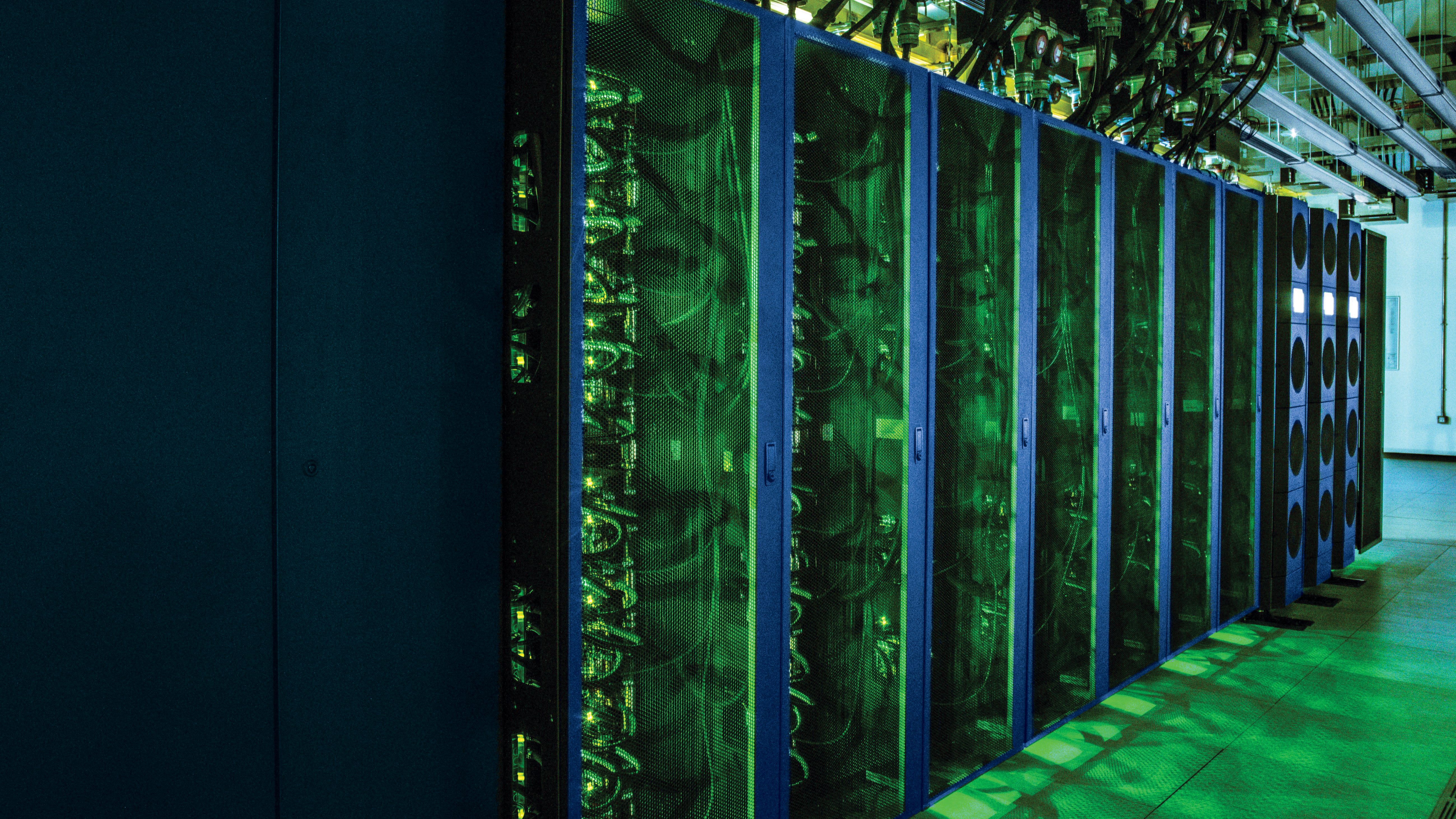
Image of the Mary Coombs supercomputer at the Hartree Centre
Mixed precision computing adjusts algorithms to apply lower precisions where it is safe to do so, with higher precision reserved only for the most sensitive parts of the calculation. This can reduce memory requirements, improve performance and lower energy consumption on modern computing systems whilst maintaining accuracy.
Through our Fusion Computing Lab collaboration with the UK Atomic Energy Authority, we are helping to build digital twins of tokamaks which will support the development of commercial fusion energy. Mixed precision computing could play a vital role in making these large-scale simulations run faster and with lower energy consumption, which is essential as we work towards national and global net zero goals.
The Promise of Neuromorphic Computing
Neuromorphic computing is an emerging technology and conversations at SC25 explored its potential with genuine enthusiasm. It is clear that this technology will need a global approach to reach the scale required for impactful real-world deployment. Neuromorphic computing, also known as neuromorphic engineering, is an approach to computing that mimics the way the human brain works. It involves designing hardware and software that simulate neural and synaptic processes so that systems can process information in an efficient, event driven and highly parallel manner.
What particularly caught my attention was how neuromorphic computing could support optimisation problems. This is directly relevant to work we are doing with Alder Hey Children’s Hospital as part of our collaboration with NHS partners. Optimisation underpins many challenges in healthcare such as scheduling operating theatre capacity or modelling clinical pathways. As we continue to explore how emerging technologies can improve healthcare outcomes, neuromorphic computing represents a promising avenue for solving these kinds of complex challenges. I am very keen to see how this field develops especially as we look for new ways to apply advanced computing to benefit clinicians and patients.
A Global Approach to Grand Challenges
Events like SC25 and the LCR AI Summit have made it clear that addressing the biggest challenges in society requires global collaboration. Whether we are exploring neuromorphic computing, mixed precision algorithms or the wider role of AI in scientific computing, progress depends on working across international laboratories, industry partners and academic institutions. Simply creating faster systems or bigger computers is not enough, you need the knowledge, tools and skills to use them effectively so that you can directly help society. To tackle these issues we need to bridge the gap between advanced computing and industry. At the Hartree Centre we are helping to create real world impact that helps organisations of any size to explore and adopt emerging technologies and upskill through our training courses.
Join Newsletter
Provide your details to receive regular updates from the STFC Hartree Centre.