Improving marine environmental monitoring with AI
STFC Hartree® Centre collaborated with IBM, Plymouth Marine Laboratory (PML) and the University of Exeter through the Hartree National Centre for Digital Innovation (HNCDI) to improve marine monitoring using AI.
Challenge
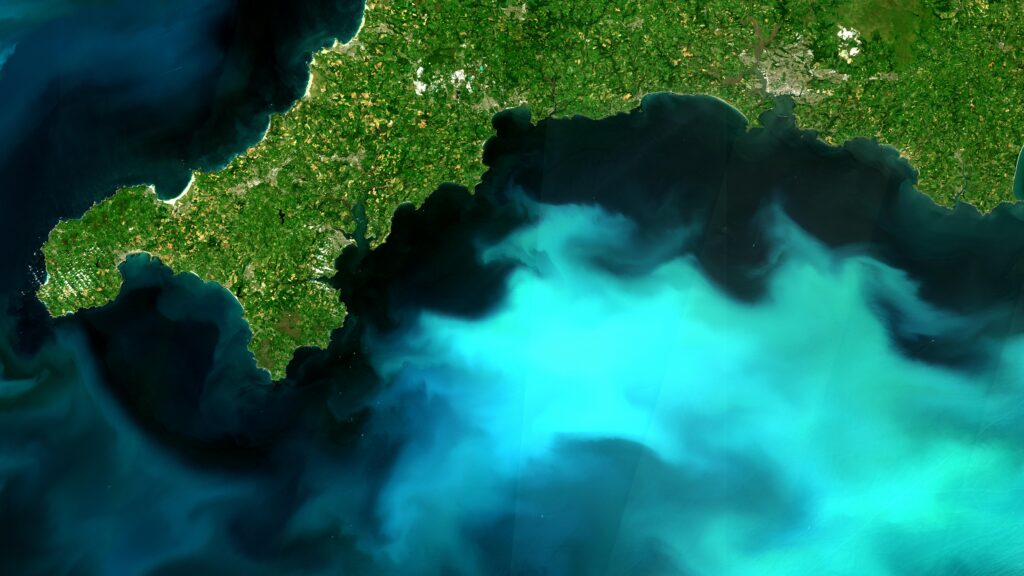
Reliable information about the marine environment is essential for research, policy and industry alike, yet it remains difficult to monitor oceans consistently at scale. Satellite data offers global coverage, but most geospatial AI models are designed for land-based imagery and do not transfer well to ocean data. Sentinel-3, part of the EU Copernicus programme, is a satellite mission designed to monitor oceans and land, providing measurements such as ocean colour and sea surface temperature. Its data differs significantly from typical land imagery in resolution, wavelength and processing requirements, limiting its use in existing AI systems. This constrains applications such as harmful algal bloom detection and monitoring phytoplankton activity that underpins the global carbon cycle.
Approach
Alongside our partners, we investigated how geospatial foundation models can be adapted to new satellite missions more efficiently. The team used a similar architecture to IBM’s Prithvi AI model. The foundation model was pretrained in a self-supervised manner using unlabelled Sentinel-3 ocean images, allowing the model to learn the characteristics of marine environments. The model was then fine-tuned for chlorophyll estimation and predicting primary production, providing accurate estimate and spatial patterns of phytoplankton levels across large areas of ocean. The work combined scalable AI development with marine and remote sensing expertise.
Benefits
This work demonstrates a practical pathway for extending foundation models across different types of satellite data, reducing development time while improving flexibility and performance. For industry and environmental organisations, this enables more reliable and scalable monitoring of marine conditions, supporting potential applications such as early warning of harmful algal blooms and improved assessment of ocean productivity. For researchers, it provides a new approach to integrating diverse Earth observation datasets within a single AI framework. More broadly, the project shows how advanced AI can help turn complex satellite data into usable insight for environmental, economic and scientific decision-making.
“Working with the Hartree Centre has allowed us to harness large-scale AI to explore new insights from ocean satellite data, helping to improve how we detect and monitor critical processes such as ocean productivity.”
David Moffat, Plymouth Marine Laboratory
Join Newsletter
Provide your details to receive regular updates from the STFC Hartree Centre.