
Transforming the healthcare sector
Healthcare is facing rising patient demand, longer wait times and declining staff wellbeing, with many reports of burnout and staff sickness. The UK’s Industrial Strategy 8, developed in collaboration with the government’s 10-year health plan, strives to harness digital transformation and innovation to address these challenges and deliver meaningful benefits across the sector. This page will explore how we have driven impact across healthcare.
What do we mean by “Impact”?
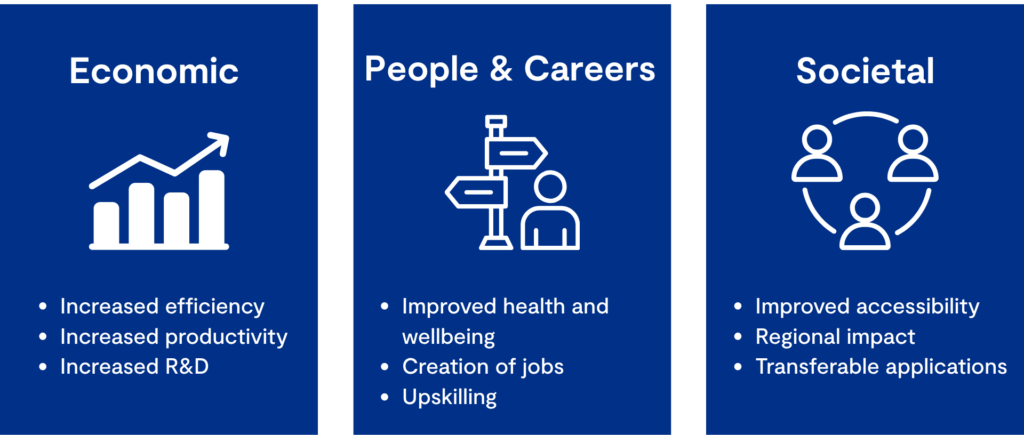
“Impact” is the value created by public investment in research and innovation. This includes knowledge creation, innovation adoption or productivity uplifts. We deliver a broad range of interventions to address industrial challenges and achieve sector objectives. In healthcare, we have delivered significant benefits across the following main areas:
Increasing efficiency, advancing knowledge and building collaboration:
The UK invested approximately 11.4% GDP into healthcare in 2025. This includes supporting the NHS productivity plan, which aims to utilise technology and digital innovation as key drivers in unlocking necessary productivity gains within the healthcare sector.
We have helped optimise healthcare processes by automating clinical administrative tasks and unburdening consultants. In a recent collaboration with Alder Hey Children’s Hospital and Alder Hey Innovation, our experts implemented an AI-driven staff scheduling system. This removed complex and highly manual administrative tasks from the workload of skilled clinicians, giving them more time to focus on patient-facing work, as well as research and innovation.
‘Sometimes the most impactful innovations are often the simplest, and improving how we build our rotas is a perfect example of technology giving clinicians more time to care.
Using AI in this instance demonstrated how improved efficiency and reduced staff workload can improve resilience and retention, creating a more sustainable and productive workforce.
Optimising workflow is a common outcome across our projects, with applications helping increase workplace efficiency. One project reported that a manual task which previously took three working days, is now completed in 15 minutes.

Another way we have helped to optimise workflow is by streamlining R&D in the discovery of new treatments and enhancing understanding of how individuals respond to therapies. Working in collaboration with industry partners such as AstraZeneca, we are investigating the potential of quantum computing to enhance the accuracy and efficiency of the drug discovery and development process. This is further supported by medical data sharing. Working with Wrightington, Wigan and Leigh NHS Trust, we built a tool capable of assessing the usability and privacy risk of patient data, ensuring safe data processing and secure sharing for responsible use.
“Quantum computing holds exciting potential to transform drug discovery and development—especially when applied to the right challenges, where its unique strengths can truly shine.”
Improving patient and staff wellbeing, upskilling and job creation:
Increasing demand for healthcare is impacting both access to services and the quality of care provided in the UK. The use of innovative, new technologies can help to mitigate these challenges. In collaboration with Cleveland Clinic London, a private hospital based in London, IBM and the Hartree Centre’s AI team used data science, AI and quantum computing to examine how hospital procedures have affected patients’ health and their overall quality of life.
Alongside this, we are advancing innovative, person-centred healthcare approaches. By developing less invasive, autonomous monitoring at home and remote assessment tools, these applications demonstrate how investment in AI can significantly reduce pressure on staff while enhancing service quality. We worked with MyMood to improve the patient journey and reduce staff workload by developing an app that combines mental health questionnaires with personalised support recommendations, while exploring expanded language options to reach wider audiences.

Additionally, upskilling staff and pursuing advancements in the application of digital technologies in the healthcare sector not only provides operational and social benefits but also creates new high-skilled jobs within data and technological roles with domain expertise. To support this, we have had 394 enrolments from healthcare professionals across our Explain courses.
Reducing costs and driving economic growth:
The Guardian reported that the NHS spends £14.7bn a year treating patients in England hurt by care mistakes. One way you can tackle this is by streamlining processes, reducing costs and improving service delivery through the adoption of digital technologies and innovation. For example, in the development of personalised medicine, where genetic profiles guide diagnosis and treatment, we partnered with the Cleveland Clinic to use quantum computing to analyse large datasets and identify molecular features predicting surgical response in epilepsy patients. This enables healthcare providers to personalise treatment plans, improving outcomes while reducing the cost of ineffective or adverse treatments.
Additionally, we worked with REPROCELL to develop a machine learning platform that streamlines the analysis of drug development data. This helps researchers identify the individual differences that influence drug response and clinical outcomes, supporting a new commercial service that improves trial success and demonstrates how innovation drives growth and competitiveness for SMEs.
Another key challenge for the healthcare sector is workforce retention and associated costs. From 2024-2025, a reduction in the use of agency staff resulted in the NHS saving almost £1bn. Harnessing innovation has the potential to further improve staff strain and sickness rates, thereby reducing the reliance on temporary workers and supporting NHS savings. Working with Alder Hey Children’s hospital, we developed and implemented an AI-assisted chatbot to inform hospital staff about Covid-19 guidance. This proof-of-concept supplied hospital staff with quick, 24hr answers around the latest policies and guidance, improving their knowledge and confidence. This approach, driven by a digital solution, is particularly helpful in situations where national guidance is changing quickly, or complex and the results include reinvesting valuable staff time and relieving pressure on staff.
Increasing accessibility and regional reach
In addition to our base in the North West, the Hartree Centre has three regional SME hubs based across the UK in Cardiff, North East England and Northern Ireland. These hubs provide on-the-ground support for local businesses and deliver impact to each of these regions.

The Cardiff SME Hub they have created a wellbeing conversational agent where the user could interact and receive tailored advice based on a questionnaire, the current conversation and help available.

The North East SME Hub developed an interactive visualisation tool to simplify complex data and to allow medical staff find assets quickly and easily.

The Northern Ireland SME Hub created a digital mental health platform using advanced AI, cloud-based data solutions and predictive analytics to personalise treatment and enhance therapy outcomes.
What’s Next?
The Hartree Centre is committed to continuing to expand its reach and engagement across industry and public sectors such as the NHS, to advance knowledge and improve lives across the UK. Recently we have launched a new programme funded by Innovate UK, which will offer SMEs collaborative projects with our team of experts to help them adopt and scale up using HPC, AI and frontier technologies.
We work in partnership with industry to develop solutions for real-world challenges and explore innovative technologies that are relevant and valuable.
Join Newsletter
Provide your details to receive regular updates from the STFC Hartree Centre.