

Launching the Smart Energy Data Service (SENSE)
The Hartree Centre and Energy Systems Catapult have recently launched the Smart Energy Data Service (SENSE), one of six services funded by the Smart Data for Research UK consortia from the Economic and Social Research Council (ESRC). We spoke to Hartree Centre team members working on the project, Dave Meredith, Bhargav Garikipati and Dylan Bennett, to find out more about the project and hear all about the launch event.
Smart SDR UK is the UK’s new national programme for smart data research. The mission is to unlock the power of data generated through everyday interactions with digital devices, and to help researchers access and use this data to understand the way we live and address broader social, economic and environmental challenges.
SENSE is one of six specialist data services that are part of the programme: Geographical, Financial, Health & Sustainable Places, Imago for Satellite Imagery, Smart Donation, Smart Energy Data Service. SENSE provides secure access to data from power networks, electric vehicles and energy meters.
SENSE will be delivered in collaboration with partners from the Energy Systems Catapult, the University of Oxford, the Counting Lab, University of Birmingham, University of Bristol, University of Leeds, Leeds Beckett University, University of Reading and UCL.
Going live… to a live audience
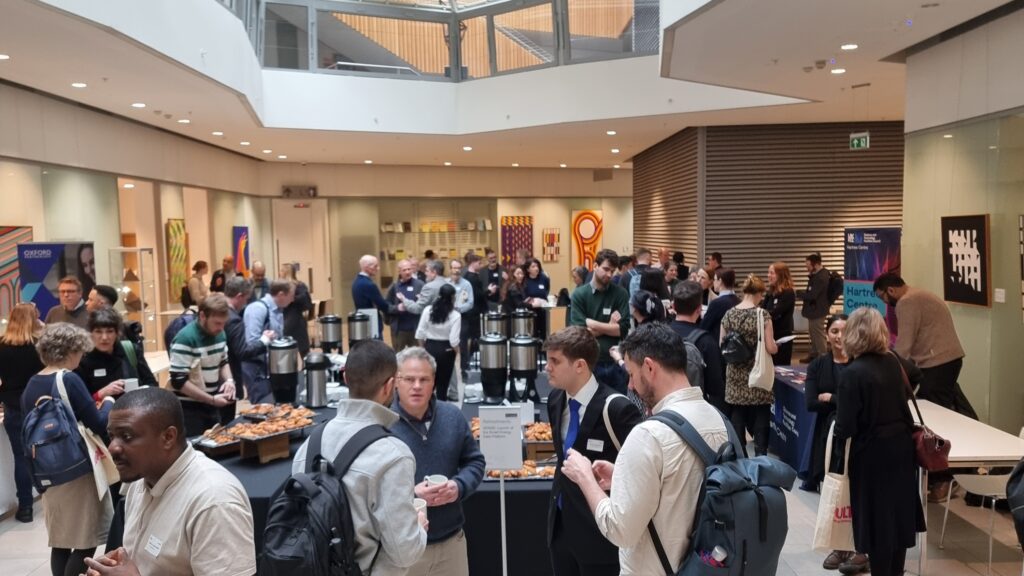
The launch event was held in March 2026 at the University of Oxford Institute of Mathematics and attracted over 100 stakeholders including end users, collaborators, and funders. The event featured a ‘go-live’ presentation by Dr Richard Snape from the Energy Systems Catapult, where the service was shown to the public for the first time. The audience was invited to following along live on their laptops to register an account and get started with the service.
Dave Meredith shared: “It was quite the nail-biting moment, we were sat at the back of the auditorium and in-front of us lay a sea of laptops all following along in real-time. The go-live gods were behaving that day, and we sighed with relief when everything went smoothly. There were plenty of comments from the audience during the Q&A session, one commenter said: “This is great, it’s exactly what we need!” which is always a good sign.”
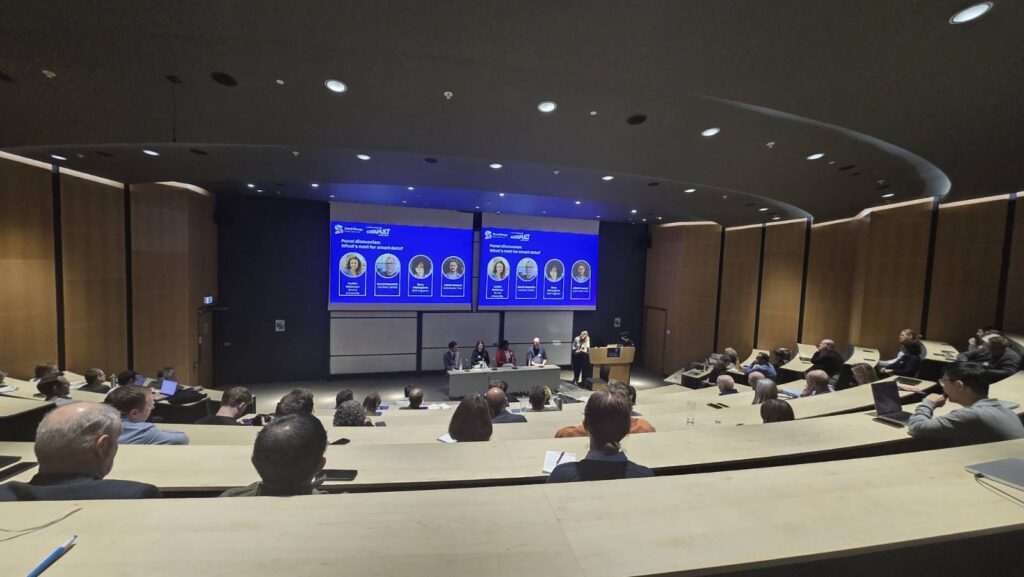
Dave also participated in an afternoon panel session where he spoke about some of the more novel features of the service.
“Our team has built the SENSE platform as a modern data lakehouse from scratch to address the use case. It uses only open-source components. Much like a shared database, it allows structured table-data to be queried ‘in-situ’ using standardised protocols from any compatible client. Users can slice and dice result-sets using custom queries and return query result-sets, just like a database. A lakehouse is far cheaper to run than a classic database by using inexpensive object storage and facilitates federated query across multiple repositories.”
How does it work?
Bhargav Garikipati explained how the platform differs from a standard database:
“SENSE runs without an ‘always-on’ database running on the server – instead data is stored in cost-effective S3 object storage, and the query engine is shifted to the client with use of compatible client libraries such as Py-IceBerg, Presto, Trino, DuckDBClient. The main benefit is significantly cheaper running costs compared to classical warehouse platforms; it is the client workstation that does the majority of the computation.
“Another benefit it has is federated query. If your client library supports connections to multiple Iceberg lakehouses such as Trino/Presto, you can connect to multiple lakehouses in a single session to perform queries and join across different tables across multiple services.”
Dylan Bennett added:
“The platform features a plugin developed using WASM (WebAssembley). WASM runs at near-native speeds within the browser, its far faster and more efficient that JavaScript (a user’s browser is just regarded as another lakehouse client). The WASM ‘Table Explorer plugin’ allows you to perform live queries on tables and produce several different visualisations and charts directly within the browser – it’s very cool!”
What could it be used for?
“SENSE could be used for a wide variety of applications,” Dylan explains, “but some examples include ensuring the transition to electric vehicles is handled fairly across the UK, without giving an advantage to higher income families. Another use case we’ve explored is optimising energy use in non-domestic buildings, such as hospitals. If we can find ways to manage energy usage more efficiently, we could redirect the cost savings into funding more or improved public services.
“The platform offers real benefits to understand UK energy use. For example, researchers can combine our UK wide footfall dataset with our UK wide smart meter dataset, to create a national dataset of energy use per person. This is possible across our whole range of datasets on SENSE, providing a smarter and more sensible way of doing research.”
This launch marks the first release of the platform; the SENSE team will be building it out further and refining it over the next two years of the programme.
Find out more on the SENSE website, or start your search for datasets!
Read the SENSE launch press release.
To hear more about the overall programme, visit the Smart Data Research UK website.
The team working on SENSE on behalf of the Hartree Centre includes: Dylan Bennett, Isaac Dowling, Bhargav Garikipati, Simona Graur, Ayman Izzeldin, Dave Meredith, Hashim Mohammed and Danuk Udagama.
Join Newsletter
Provide your details to receive regular updates from the STFC Hartree Centre.