
The Hartree Centre at SC26
This week we’ve been at SC26, the largest international HPC conference, attracting more than 23,000 attendees from around the world. We sent a team of 8 staff who represented the STFC Hartree Centre through workshops, the exhibition and events at the conference.
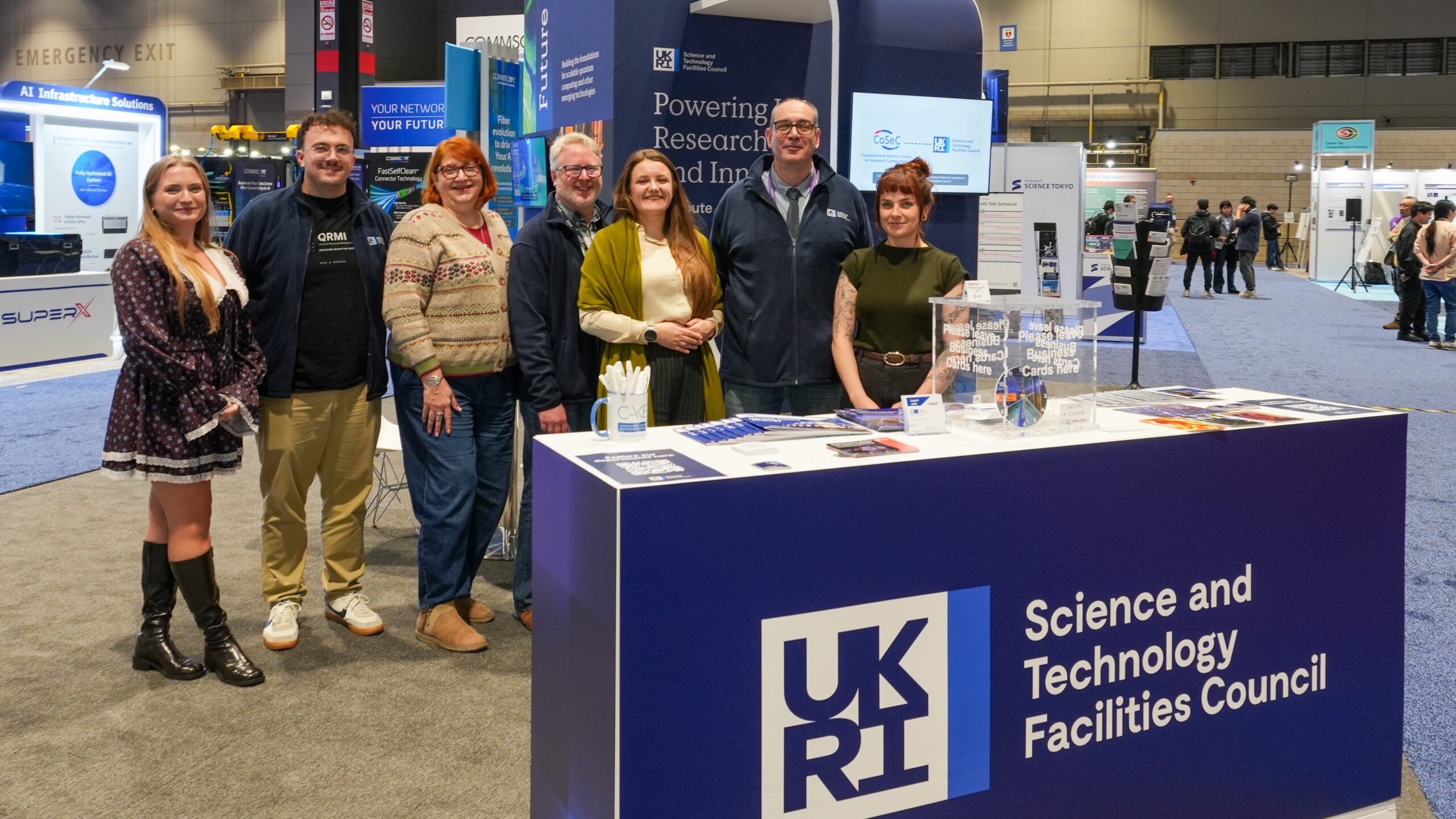
Hartree Centre Team at SC26
“The conference is packed with all the latest and greatest technology in HPC, AI/ML, and now quantum computing, all under one roof. I can speak directly with the technical experts that design and build these technologies, which helps me enormously when evaluating the needs of our users/customers so that I can build the systems they need. As always, I have finished the conference with a notebook full of ideas that could help our users and improve our services and keep us at the forefront in the realm of HPC.” – Edward Taylor, Computing Infrastructure Architect, Hartree Centre
Recognition of our quantum work
Over the last few years, quantum computing has increasingly gained attention at the conference, and this year some of our work in this space was recognised by HPCWire, a leading news and information source for the high performance computing community.
Below, Oscar Wallis, one of our Quantum Software Engineers, briefly discusses our award, the Readers’ Choice for Best Quantum Computing Integration with HPC/AI, and our work in this area.
Oscar Wallis discussing our work on QRMI and our related HPCWire award
On the exhibition floor
We took part in the exhibition, representing STFC alongside STFC Scientific Computing and the National Quantum Computing Centre (NQCC). Together we brought the unique computing capabilities of STFC to SC26 to demonstrate how we enable the discovery, adoption and exploration of cutting-edge digital technologies for the UK’s research and innovation landscape. The exhibition space allowed us to connect with familiar faces and new ones, and to engage with decision-makers and collaborators in the heart of the exhibit hall.
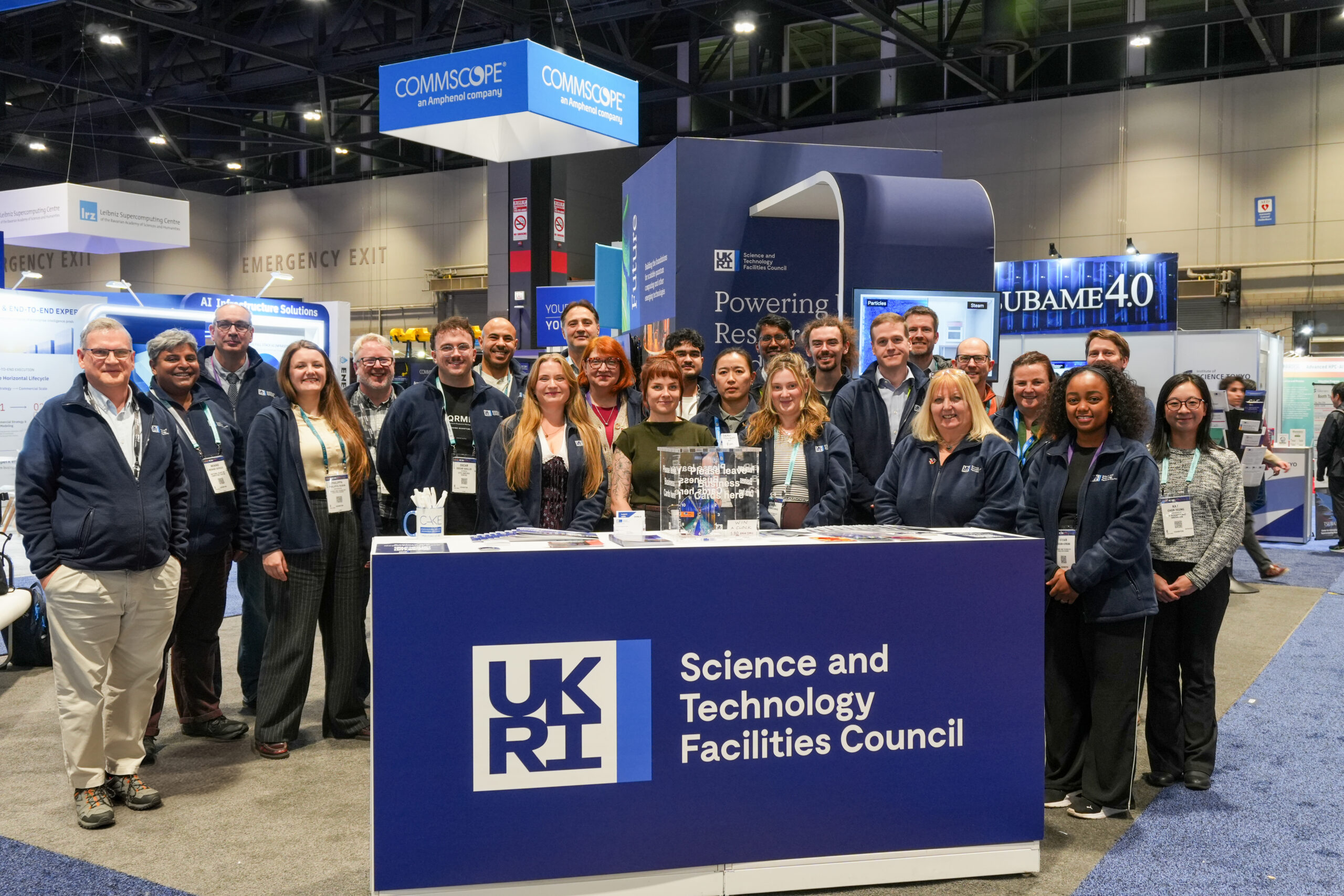
The full STFC team at the exhibition booth
Art of HPC Exhibition
In the Art of HPC exhibition, artists were able to display their creativity, showing new perspectives and exhibiting beauty in unexpected places. By leveraging cutting-edge technology and resources, submissions pushed the boundaries of both science and art. On display were works that met at the intersection between artistic creativity and high performance computing.
“It was interesting to see how different the submissions were for this year’s exhibition. Some focused on turning scientific outputs into more beautiful representations. Meanwhile, others created abstract art from HPC concepts. I was incredibly proud to see that our work had been chosen as the title image and had great conversations with attendees that were inspired to push their own scientific outputs to be more aesthetically engaging and impactful. Through the exhibition and our own visualisation postcards, I made connections with those in vis at other organisations, where we’re hoping to engage further on visualisation workflows.” – Kelly Raymond, Visualisation Software Engineer, STFC Hartree Centre
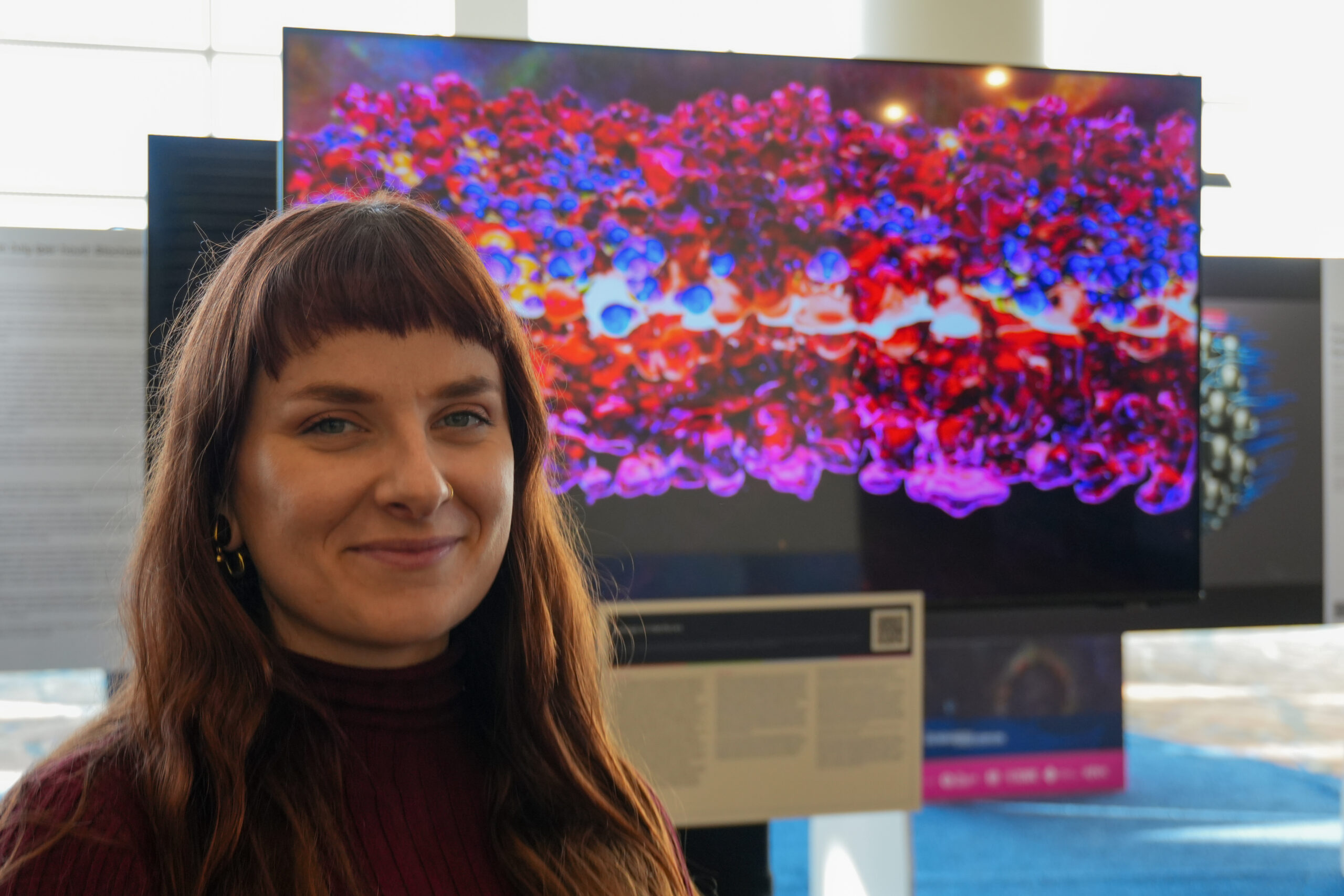
Kelly Raymond with her Art of HPC submission
Our workshops
We hosted two workshops: the 17th Workshop on Latest Advances in Scalable Algorithms for Large-Scale Heterogeneous Systems (ScalAH’26) and the 13th Workshop on Best Practices for HPC Training and Education. We attend SC every year to reconnect with the community, and our annual workshops give members of these communities a platform to speak about their work.
The ScalAH’26 session began by highlighting the GENESIS mission, which aims to create a coordinated scientific superintelligence discovery system that can enable discovery for national grand challenges. Long term, GENESIS will work towards superintelligence being capable of performing sustained discovery through experimentation and simulation by drawing on scientific literature, retaining evidence, and originating theories which it can validate against observations and experiments.
The rest of the session explored a range of approaches to integrating emerging and classical computing paradigms at scale. A common theme was that, as modern HPC and AI systems become increasingly heterogeneous, making effective use of these resources requires more than simply bringing different types of hardware together. It demands better coordination of device scheduling, data movement, and execution across the system, treating hybrid applications as end-to-end workflows, not just isolated quantum or classical tasks.
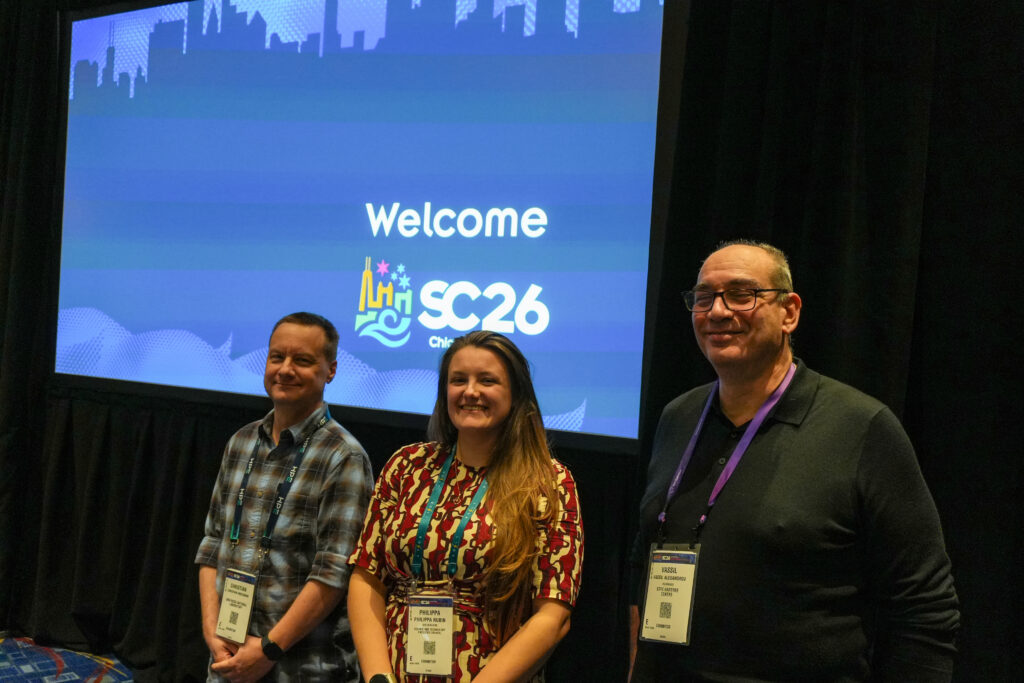
Workshop organisers Vassil Alexandrov, Philippa Rubin and Christian Engelmann
“It’s been a great week in Chicago representing STFC Hartree Centre. Between welcoming so many people to our booth and chairing the ScalAH’26 workshop on scalable algorithms, the energy and ideas across the global HPC community have been inspiring. It was particularly valuable to see international approaches to challenges we are tackling back home, including Sovereign AI, HPC-Quantum Integration and Nuclear Fusion. Hearing how others are approaching these areas is a great reminder that they are shared global ambitions.” – Philippa Rubin, Software Engineer, Hartree Centre
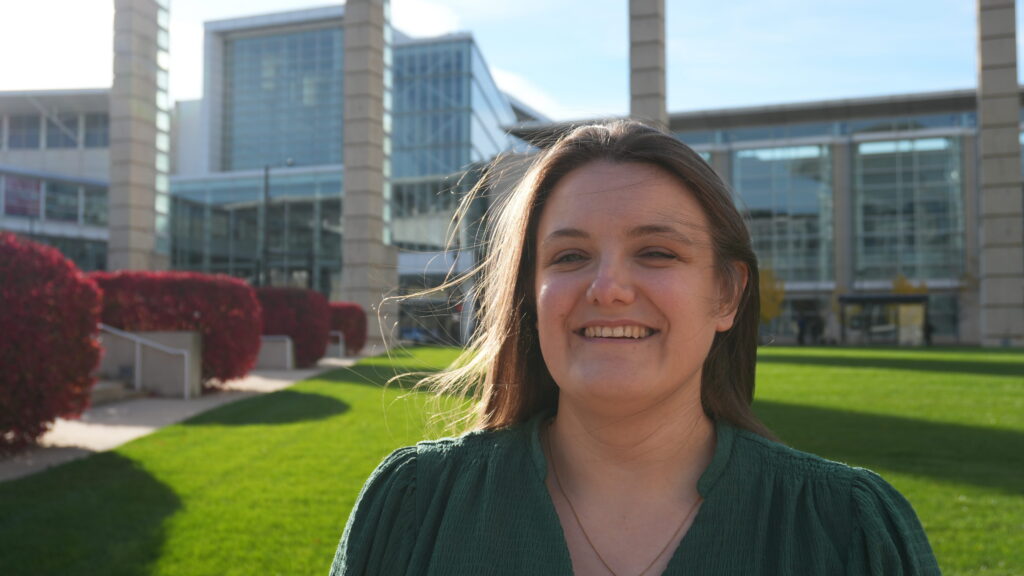
Philippa Rubin
Our training workshop saw speakers share their experience embedded in the community. They described how they are supporting the next generation of HPC users, the challenges they encounter with infrastructure access barriers, and how they capture their impact and make a difference to students and educators.
Some key themes that came up during the session included:
The content we are delivering: Are we teaching what students actually need to know, and how can we support them with reasoning and system literacy?
How we are structuring and iterating on training programmes: How can we create fluid environments where students and educators work together to help everyone progress, particularly as HPC is usually learned as an addition to STEM rather than as part of it.
How we are applying different learning theories: How should we approach educating the next generation of HPC users to make sure they learn the essentials and how to adapt to a shifting landscape.
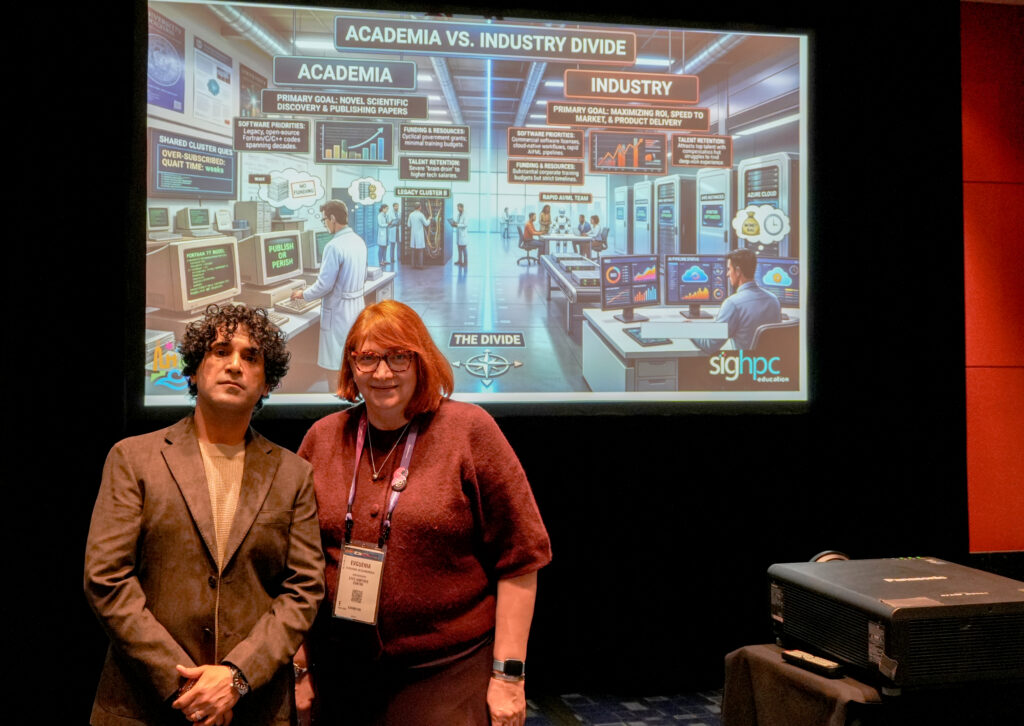
Workshop organisers Nia Alexandrova and Nitin Sukhija
Our Training Manager, Nia Alexandrova, commented on the conversations around HPC training at the conference:
“Most of the BoFs and panels discussing skills and education revolved around the central question of ‘will AI agents do the job of computational scientists?’ – will we lose control on what it is investigated and how this is approached? The community discussed the importance of upskilling in AI and agent direction, and understanding how to validate results. We, as trainers and educators, need to enable researchers to be in control of these new and very powerful tools.”
SC26 was a reminder of how much the HPC community can achieve when it comes together. We return to the UK with new ideas, new connections and a clearer view of the shared challenges ahead. If you’d like to talk to us about anything you’ve read here, we’d love to hear from you.
Otherwise, we’ll see you at SC27!
Join Newsletter
Provide your details to receive regular updates from the STFC Hartree Centre.